Ahmad Jamal

.jpg)
Ahmad Jamal, né Frederick Russell Jones à Pittsburgh le 2 juillet 1930, mort le 16 avril 2023. Il dirige des petits ensembles de 1951 à sa mort, et décrit son travail en termes d’orchestration plutôt que de trio : « I only think orchestrally. That’s the thing. And I draw upon a vast repertoire. »1 Il rejette le mot lui-même : « I hate the word ‘trio’ now. It’s limiting as to what I do. […] Basically, I’m a writer and an orchestrator. »2
Une conception orchestrale
Jamal rattache cette conception à sa formation à Pittsburgh : « I worked with a lot of orchestras coming up. […] I began in the school orchestra when I was 11 years old. That orchestral approach came from Pittsburgh. I still hear orchestras in my head. »3 Interrogé sur sa source directe, il cite Erroll Garner, autre pianiste de Pittsburgh : « They don’t come any more orchestrated than Erroll. He’s an orchestra within himself. He was my biggest influence. »4
Les parties sont écrites. Les lignes de basse sont de lui, à une exception qu’il nomme : « Most of the bass lines I myself have done. The rare exception was the bass line that Israel played on “Autumn Leaves”. […] So most of the things, 99 percent of the things, I write. »5 Et : « We rehearsed a lot and I wrote a lot. I had a big thick book. Most of the things I charted. »3
Gil Evans a repris « New Rhumba », enregistré par le trio en 1955, pour le grand orchestre de Miles Ahead. Jamal : « All Gil did was take every trio part, everything we’re doing, and make it conform to the orchestra. He didn’t need to do anything but have the skill to do that. All the music is constructed that way. »3
Son album de 1955, en trio piano, guitare et contrebasse, s’intitule Chamber Music of the New Jazz4. Ce premier trio était sans batterie pour une raison de projection sonore, et non par choix esthétique : « the group I had was far too subtle to continue working in the various venues, because guitar and bass sometimes are lost in the bigger venues, so I went to drums as a result. »5
L’espace et la nuance
Miles Davis, dans son autobiographie : « He knocked me out with his concept of space, his lightness of touch, his understatement, and the way he phrased notes and chords and passages. » Et, en termes fonctionnels : « Listen to the way Ahmad Jamal uses space. He lets it go so you can feel the rhythm section and the rhythm section can feel you. It’s not crowded. »4 Davis envoyait sa section rythmique écouter le trio au Pershing, et donnait à Red Garland la consigne « play like Jamal »32.
Un portrait d’Ebony de 1961 relève qu’il pouvait rester seize mesures sans toucher une touche pendant que la section rythmique jouait6. Keith Jarrett : « This is swinging more than anything I’ve been listening to, but they’re doing less. What’s the secret here? With Ahmad, the intensity was in the spaces. »2
Deux points contredisent l’image du pianiste soliste. Le plan est arrêté à l’avance et il n’improvise pas en permanence ; sur « Poinciana » il ne prend pas de chorus7. Et la nuance fonctionne comme un paramètre d’arrangement. Vernel Fournier, batteur du groupe pendant huit ans : « Ahmad used difficult dynamics, and so many of them. […] He could play one tune five or six ways. He might insert something from another tune into the tune you’re playing, and would want you to play the appropriate accent when he did it. You had to be conscious at all times that he was playing the piano. »8
Jamal préférait le mot discipline à celui d’espace. Harold Mabern : « People always said he used a lot of space; he’d rather call it discipline. »2
La direction par signes


Le matériau est fixe, l’ordre des sections est décidé en jeu. Herlin Riley, batteur du groupe à partir de 1982 :
« Everything is cued. The music has a structure, it has a form, but he gives you hand signals to direct you inside of the form. It tells you if you’re playing the top of the head section, the A-section or whatever, then he’ll give you another cue for the bridge, then he’ll give you another cue for the interlude. So if he wants you to repeat any of those three cycles, he can just give you the same cue to repeat it over and over. […] So the music is constantly being shaped and arranged on the spot. »5
La batterie n’est pas écrite. Fournier : « Nobody writes for drums. […] They always try to get some kind of an input from you. » Jamal posait la mélodie et la ligne de basse, les mettait en place avec le bassiste, et le batteur cherchait ensuite. L’instruction ne passait pas par les mots : « very seldom would he speak to you about your playing. I don’t think he ever told any drummer that was with him to do this or do that. […] But if there was something in particular he wanted, he would repeat it with the piano many, many times until you understood what he was saying. »8 Riley cite une seule consigne verbale : « Don’t fill in every time the phrase comes around; you don’t have to play a fill. »5
Le rôle de la contrebasse est défini par Jamal : « the bass essentially has to be an extension of your left hand […] And I’ve also sought those bassists who had sensitive ears, who had the ability to hear. »5
Le traitement des standards
Michael Cuscuna observe que lorsque Jamal remettait en circulation un morceau délaissé, celui-ci restait au répertoire, et que pour « Poinciana » ou « Billy Boy », c’est son arrangement qui est devenu la forme de référence3. Colin Fleming, à propos de « Who Cares » : les crédits et les royalties allaient à d’autres, mais « it’s almost as if Jamal has taken a text and composed new elements throughout it, and in addition to it. There’s playing-playing, and there’s composing-playing. »9
Les procédés récurrents :
- Vamp d’ouverture sans harmonie. Sur « Poinciana », basse et batterie installent le groove avant l’entrée du piano ; Ethan Iverson note qu’il n’existe guère de précédent pour un trio de piano7. Sur « There Is No Greater Love », Iverson décrit une syncope d’ouverture dérivée de la clave, et ajoute : « this kind of opening move was not yet a standard gambit for a piano trio. It was Ahmad Jamal who made it a standard gambit. »7
- Pédale harmonique. Sur « Moonlight in Vermont », l’harmonie est tenue au-dessus d’une pédale, avec des phrases de six mesures au lieu de huit7.
- Intros, interludes et codas composés. Ils sont autonomes au point d’avoir été coupés : la discographie Mosaic signale que les introductions de piano de deux titres du Blackhawk 1962 avaient été retirées des versions publiées et sont rétablies dans le coffret3.
- Étirement de la forme. Marcus Roberts : « On a straight-ahead AB tune like “Autumn Leaves”, Ahmad would expand the A-section until he had nothing left to play, then he’d move to the bridge and use a totally different groove. »2
L’arrangement de 1958 est détaillé dans Poinciana.
Technique pianistique
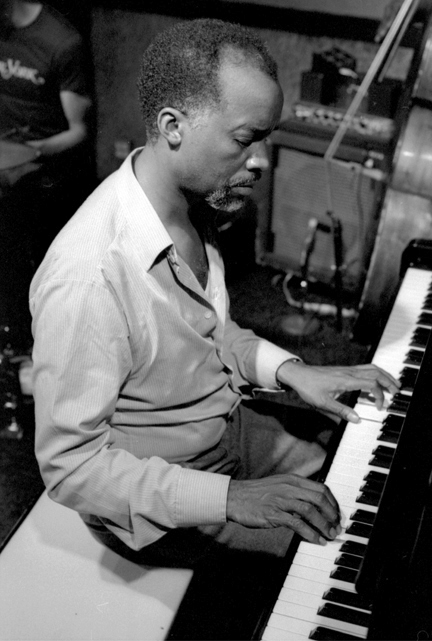

Toucher. Harold Mabern : « his touch, which I call the Franz Liszt touch. A lot of pianists might have equal technique, but their touch and sound distinguish them. That’s the way Ahmad and Art Tatum are. »2 Jamal jouait l’étude Eroica de Liszt en concours vers dix ou onze ans2. Interrogé sur un travail conscient du toucher, il répond par Horowitz : « he’s playing the same repertoire, but it’s his touch that makes the difference. […] everything lies in the touch. »10
Registres. Tommy Flanagan : « Ahmad Jamal’s concept is orchestral. He has a wide knowledge of the keyboard, and he uses all of the keyboard all of the time. »5 Iverson relève que le premier chorus de « The Surrey with the Fringe on Top » au Pershing est joué à la main droite seule, dans l’aigu7.
Block chords. Riccardo Scivales compare, transcriptions à l’appui, le « Billy Boy » de Jamal (1957) et celui de Red Garland (1957, puis Milestones, 1958). Chez Garland : mélodie à la main droite en octaves avec une quinte juste insérée au milieu de l’octave, main gauche en accords de quatre notes sans fondamentale, en homorythmie. La différence relevée : Jamal place des sixtes majeures ou mineures au milieu des octaves de main droite là où Garland met des quintes justes11.
Deux attributions courantes sont à écarter. Jamal dément l’influence de George Shearing sur ses block chords : « I didn’t learn anything from George Shearing; we’re peers. I mean I admired George, but my influences were Erroll and Nat and Art Tatum », et renvoie à Phineas Newborn pour l’étude du procédé10. Quant à son rôle de pionnier des voicings sans fondamentale, il n’est adossé à aucune source primaire, et Scivales attribue cet usage précoce et systématique à Garland11.
Main gauche. Elle est réglée sur le bassiste. Marcus Roberts : « Israel Crosby played all kinds of hip stuff underneath, but Ahmad’s left hand was never in the way of Israel’s harmonic direction. »2 Selon Iverson, le choix entre accord avec fondamentale dans le grave et voicing sans fondamentale relève chez lui d’une décision d’orchestration relative à la contrebasse ; sur « There Is No Greater Love », la main gauche marque les contretemps, dans la section rythmique7.
Pédale. Aucune source trouvée à ce jour ne documente sa pédalisation. Point à compléter.
Rythme
Mabern sur la stabilité du tempo : « if Ahmad Jamal’s time was the brakes on a car, you would never have an accident. His time is impeccable. He will play a run and stop on a dime. »2
Cuscuna décrit l’effet de ses interruptions : il entre progressivement dans la mélodie et coupe au moment où la reconnaissance s’installe, souvent avant la fin de la phrase3. Fleming décrit le même procédé en termes de durée : compression par retrait de notes, dilatation par insertion de silences, un nouveau thème émergeant de l’intervalle de repos9.
La polymétrie est documentée par ses deux batteurs. Fournier, sur « This Terrible Planet » (Extensions, 1965) : une métrique à 6/8 où 1, 3 et 5 sont à la grosse caisse et 2, 4 et 6 à la caisse claire, « so it was like a 4/4 fighting the 6/8 »8. Riley : « he would play sometimes a tune in 6/8, and we’d get into the 6/8 feeling, and inside that 6/8 feel he would impose a regular 4/4 meter over the top of that, so you’re playing two different meters at the same time. » Il mentionne aussi des mesures de 3/8, 5/8 et 7/8 insérées dans le cycle5. Jamal, lui, relativise : « The little variety of time signatures that I do are absolutely natural. […] That’s the Pittsburgh influence. »5
Le motif de batterie de « Poinciana » revient à Fournier. Jamal : « Not a word did I ever mention, and not a word did I mention on the lines Israel played on “But Not For Me”. That just built over a period of time, one chorus, two choruses. »3
Islam, discipline et réception
Jamal se convertit à l’islam en 1950 et abandonne le nom de Frederick Russell Jones. L’élément déclencheur est une discussion devant l’entrée des artistes du Braddock Hotel à Harlem avec le trompettiste Idrees Sulieman, lui-même converti, sur la valeur morale de la religion, qui « had everything to do with being all that you can be ». Il rejoint le mouvement Ahmadiyya, alors très implanté chez les Afro-Américains. En 2017 : « I accepted Islam because it took me from darkness into light and gave me direction. »6
Il observait les cinq prières quotidiennes, avec une importance particulière accordée à celle de cinq heures du matin, déjà mentionnée dans un portrait du New York Times de 1959 ; son album After Fajr (2005) en tire son titre. Le producteur Ed Michel rapporte qu’il a observé le jeûne du ramadan pendant l’enregistrement de The Awakening, en imposant l’arrêt de la séance au coucher du soleil. Nathan Lean fait l’hypothèse d’une correspondance entre ces interruptions rituelles de la journée et la place du silence dans son jeu, que Jamal désignait par le même mot de discipline6.
Jamal refusait le terme de jazz et lui préférait « American classical music ». Il tenait la séparation entre musique savante européenne et musique américaine pour une construction qui reconduisait des hiérarchies de race et de classe, et soulignait la continuité entre les deux pratiques : « Bach, Mozart and Beethoven all improvised. Improvisation is synonymous with freedom. »6
Une partie de la critique de l’époque le classait parmi les pianistes de bar. Martin Williams, cité par Ted Gioia : « It appears that Jamal’s real instrument is not the piano at all, but his audience. »12 Fournier y revenait encore en 1990 : pendant des années « they called him a “cocktail piano player”, which was really a drag », ajoutant « When the Judgment Day comes, I would hate to be some critics! »8 Riley avance une autre cause à cette mise à l’écart : « I think the Jazz Establishment has shied away from him, especially early on in his career, especially the fact that he changed his name, became a Muslim at a time when it was very unfashionable. »5
Iverson accorde une part de fondement au malentendu : sur « Poinciana », le jeu de Jamal est plus proche de la musique d’ambiance que du jazz de son temps, et la parenté avec les pianistes de salon s’entend ; il ajoute que ces critiques étaient manifestement incapables d’entendre l’apport de Crosby et de Fournier7.
Périodes
1951-1955. Piano, guitare (Ray Crawford) et contrebasse (Eddie Calhoun puis Israel Crosby), sans batterie. La percussion est répartie sur les instrumentistes : Crawford frappe la caisse de sa guitare pour imiter le conga, et le bassiste Richard Davis se souvient d’un morceau où il jouait des maracas tout en tenant la basse5. Chamber Music of the New Jazz (1955) contient « New Rhumba ».
1956-1962. Arrivée de la batterie, Walter Perkins puis Vernel Fournier, avec Israel Crosby. At the Pershing: But Not for Me est capté les 16 et 17 janvier 1958 : quarante-trois titres en une soirée, huit retenus. « We did 43 tracks one night. Only used 8 out of 43. I worked a whole week on the editing. »3 Le disque reste plus de deux ans au classement Billboard. Fournier signale une évolution vers la fin de la période, des balais aux baguettes et un piano « more progressive »8, audible sur At the Blackhawk (1962). Jamal ouvre son club à Chicago, l’Alhambra, en 1959 ; à sa fermeture en 1961 il dissout le trio et s’arrête deux ans.
1964-1971. Jamil Nasser à la contrebasse, Frank Gant à la batterie, retour de Fournier en 1965. Ted Panken décrit le passage du « miniaturiste élégant » de 1958 à un jeu discursif et kaléidoscopique2. Extensions (1965), The Awakening (1970), Tranquility, Manhattan Reflections.
1971-1985. Premier Fender Rhodes enregistré lors de la tournée européenne de 1971 (Freeflight, Outertimeinnerspace) ; il double couramment acoustique et électrique dans un même morceau. À partir de 1973, 20th Century Records, orchestrations de Richard Evans, reprises de Stevie Wonder, War et Marvin Gaye, et Jamal Plays Jamal. Chuck Lenatti juge que les arrangements de cette période recouvrent souvent son jeu13. Les enregistrements en concert de ces mêmes années sont à l’acoustique : le Rhodes reste largement un instrument de studio.
1985-2023. Nouvelle section rythmique à partir du festival de Montréal en 1985, Herlin Riley étant recommandé par Wynton Marsalis. Jamal se remet à composer, et formule ainsi l’évolution de ses formes : « Extended form is because of extended living. »2 Ensembles élargis avec percussion et soliste invité (George Coleman, Stanley Turrentine), puis quartette avec Reginald Veal et Herlin Riley. Derniers disques : Marseille (2017) et Ballades (2019), où « Poinciana » est rejoué sans le groove.
Écouter
- At the Pershing: But Not for Me (Argo, 1958).
- Chamber Music of the New Jazz (Argo, 1955), trio sans batterie, contient « New Rhumba ».
- At the Blackhawk (Argo, 1962), fin de la période Crosby-Fournier.
- Extensions (Argo, 1965), pour la polymétrie décrite plus haut.
- The Awakening (Impulse!, 1970). Largement samplé par le hip-hop, de « The World Is Yours » de Nas à Common et Jeru the Damaja ; les arrêts de la section rythmique y laissent des passages de piano seul isolables14.
- Emerald City Nights: Live at the Penthouse, inédits de Seattle publiés à partir de 2022.
- Ballades (Jazz Village, 2019), dernier disque, en solo pour l’essentiel.
Pour aller plus loin
- Michael Paul Mackey, From Pittsburgh to the Pershing: Orchestration, Interaction, and Influence in the Early Work of Ahmad Jamal, thèse de doctorat, University of Pittsburgh, 2017, 237 p., en accès libre. Analyse les enregistrements de trio sous l’angle de l’orchestration et de l’interaction, à partir de la théorie de l’intermusicalité d’Ingrid Monson, et se conclut sur une application pédagogique. Jury comprenant Geri Allen. Notice
- 🎼 Hal Leonard, Ahmad Jamal Collection (Artist Transcriptions, 112 p.), dix titres. Piano et contrebasse entièrement transcrits, avec une esquisse de la partie de batterie. Fiche éditeur
- Ethan Iverson, « TT 240: Ahmad Jamal, At the Pershing », analyse des huit titres du disque par un pianiste. Lire
- Ted Panken, article DownBeat de 2002 et compilation d’entretiens de première main (WKCR 1995 avec Jamal, plus Fournier, Riley, Mabern, Flanagan, Richard Davis). DownBeat 2002 et compilation
- Michael Cuscuna et Kenny Washington, notes du coffret The Complete Ahmad Jamal Trio Argo Sessions (Mosaic 246, 9 CD), avec l’entretien de 2003 et la discographie de séance. Page Mosaic
Pages liées
- Poinciana : l’arrangement de 1958, le groove de Fournier, la parenté Cuba / Nouvelle-Orléans.
Footnotes
-
Bob Pawlo, « Reflections of a Master, Insights from Ahmad Jamal », Allegro (Local 802 AFM), décembre 2017. ↩https://www.local802afm.org/allegro/articles/reflections-of-a-master-insights-from-ahmad-jamal/
-
Ted Panken, « For Ahmad Jamal’s 85th Birthday, a DownBeat Feature from 2002 », version non éditée de l’article DownBeat 2002, avec les entretiens sources (Mabern, Jarrett, Roberts). ↩↩2↩3↩4↩5↩6↩7↩8↩9↩10↩11https://tedpanken.wordpress.com/2015/07/02/for-ahmad-jamals-85th-birthday-a-downbeat-feature-from-2002/
-
Michael Cuscuna et Kenny Washington, notes de The Complete Ahmad Jamal Trio Argo Sessions (Mosaic 246), incluant l’entretien de Kenny Washington avec Jamal du 9 février 2003. ↩↩2↩3↩4↩5↩6↩7↩8↩9https://www.mosaicrecords.com/the-great-jazz-artists/ahmad-jamal/
-
Chuck Lenatti, « Ahmad Jamal: An American Classic », All About Jazz. ↩↩2↩3https://www.allaboutjazz.com/ahmad-jamal-an-american-classic
-
Ted Panken, « Some encounters with and ruminations on the transformational pianist Ahmad Jamal », 2025. Contient la transcription de l’entretien WKCR du 5 février 1995 avec Jamal, et les entretiens avec Herlin Riley, Tommy Flanagan et Richard Davis. ↩↩2↩3↩4↩5↩6↩7↩8↩9↩10https://tedpanken.substack.com/p/some-encounters-with-and-ruminations
-
Nathan Lean, « How Islam Inspired the Music of the Late Jazz Legend Ahmad Jamal », New Lines Magazine, 2 juin 2023. ↩↩2↩3↩4https://newlinesmag.com/essays/how-islam-inspired-the-music-of-the-late-jazz-legend-ahmad-jamal/
-
Ethan Iverson, « TT 240: Ahmad Jamal. “At the Pershing: But Not for Me.” Argo LP-628 », 25 avril 2023. ↩↩2↩3↩4↩5↩6↩7https://iverson.substack.com/p/tt-240-ahmad-jamal-at-the-pershing
-
Ted Panken, « Vernell Fournier on Ahmad Jamal, WKCR, 1990 ». ↩↩2↩3↩4↩5https://tedpanken.wordpress.com/2011/07/03/vernell-fournier-on-ahmad-jamal-wkcr-1990/
-
Colin Fleming, « Diggin’ the Gaps: How Ahmad Jamal Re-Tooled Jazz », The Brooklyn Rail, décembre 2010. ↩↩2https://brooklynrail.org/2010/12/music/digging-the-gaps/
-
Joe Alterman, « Interview with Ahmad Jamal », 10 mai 2011. ↩↩2https://www.joealtermanmusic.com/new-page-2
-
🎼 Riccardo Scivales, « Billy Boy and Red Garland’s block chords style », avec transcription comparée. ↩↩2https://www.riccardoscivales.com/billy-boy-red-garlands-block-chords-style/
-
Ted Gioia, « Jazz Piano Innovator Ahmad Jamal Is Dead at Age 92 », The Honest Broker, 16 avril 2023. ↩https://www.honest-broker.com/p/jazz-piano-innovator-ahmad-jamal
-
Chuck Lenatti, « Ahmad Jamal Plugs In: Funk, Fusion and the Fender Rhodes », All About Jazz, 14 juin 2024. ↩https://www.allaboutjazz.com/ahmad-jamal-plugs-in-funk-fusion-and-the-fender-rhodes
-
« How Ahmad Jamal’s The Awakening became a hip hop sampling goldmine », The Vinyl Factory. ↩https://www.thevinylfactory.com/features/ahmad-jamal-the-awakening-samples