Pentatonics & Quartal Voicings
harmonyjazz
Introduction
Quartal voicings are built by stacking intervals of 4ths rather than the traditional 3rds used in tertian harmony. The standard quartal voicing uses 5 notes, though this can be reduced to 3-4 notes or expanded to 6 notes.
- Ambiguity: Quartal chords are ambiguous. There is no clear tonal center, and each voicing can represent many different chords. This is very useful for improvised music, as it gives the soloist more freedom.
- Modern: Building chords in 4ths is considered sophisticated and «modern» compared to traditional tertian harmony (although it’s been used in jazz since the late 50s, and can be found in classical music early 20th century).
- Suspended: Due to their construction in 4ths, these voicings have a slightly suspended chord sound.
3-notes quartal voicings
All examples with actual notes (scores, keyboards) are shown in the key of C. Adapt to your actual key.
Minor 7
| 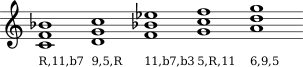 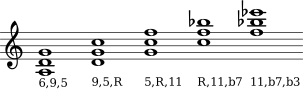 |
Dominant 7
| 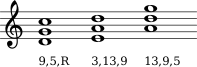 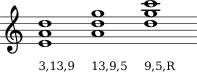 |
Altered Dominant
| 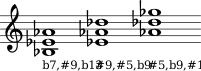 Note: chords written using flat-based alterations, which is incorrect from a music theory point of view (should be ♯9, not ♭4), but also more readable, especially because it makes it easier to compare enharmonic alterations like ♭13 and ♯5, to see the “stacking”. |
Dominant 7, Suspended 4th
| 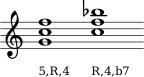 Note: both voicings are also available for minor 7, but the 4th is written as 4th here (because it replaces the 3rd) while it’s written as 11th for the minor chord (because it’s an upper extension, on top of an (eventually) existing 3rd). |
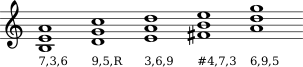
Major 7
|  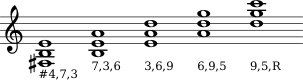 |
Minor 7♭5 (half-diminished)
| 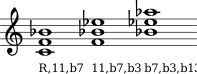 Note: voicings built from the ♭3 and ♭6 are generally avoided (and thus skipped here) because they contain a ♭9 interval, which creates unwanted dissonance. They may occasionally work in some contexts, but will sound very bad in locrian ♮9 contexts. Also, be aware that by chosing it, you deny other instrumentists the choice of the 9th quality. |
Écouter
Les artistes ci-dessous illustrent les concepts de quartal voicings et de pentatoniques dans le répertoire enregistré. Voir leurs pages dédiées pour les discographies détaillées.
- John Coltrane
- McCoy Tyner
- Herbie Hancock
- Bill Evans
- Chick Corea
- Wayne Shorter
- Joe Henderson
- Larry Young
- Pharoah Sanders
- Woody Shaw
- Keith Jarrett
- Andrew Hill
- Weather Report
Sources et approfondissement
- https://www.thejazzpianosite.com/jazz-piano-lessons/jazz-chord-voicings/quartal-voicings/
- Quartals & Pentatonics – Alan Brown
- Inside Improvisation, Vol. 2, Pentatonics – Jerry Bergonzi
- The Jazz Piano Book – Mark Levine
- The Jazz Theory Book – Mark Levine